

VOICE 182
Awatief Daniels
and Ben Henzler, founders
of Lavender&Black
Photography - HIRO Interview - MINA

”We are about naturally grown, healthy botanicals transformed into thoughtful, purposeful products. Every decision, from what we grow and how we make it to what goes into each product, is made with intention.”
Tucked away at the northern end of Salt Spring Island, Lavender & Black is reached by a scenic drive along Sunset Drive, followed by the gentle climb up Pringle Farm Road. At first, you might wonder, “Could there really be a lavender farm here?” Then, through the trees, the first glimpse of purple appears.
Anyone fortunate enough to visit Lavender & Black during peak season will likely pause at the sight. Some stop to capture the view; others take it in. Lavender fields cascade down the gentle hillside toward the ocean, embraced by arbutus, fir, and big leaf maple trees over a century old. The landscape feels like a postcard painted by nature itself. But the beauty of this place is only the beginning of its story.
In 2016, owners Awatief and Ben planted approximately 4,000 young plants on this land. Nearly a decade later, they continue to cultivate the farm largely by hand, distilling their own botanicals and creating wellness products with care.
Unlike a typical lavender farm, Lavender & Black is woven into an existing landscape. Mature trees remain untouched, and lavender grows among them rather than across open fields. Wild grasses and native plants are allowed to flourish between the rows, creating habitat for bees, butterflies, and other small creatures. Awatief and Ben believe in farming with minimal disturbance, working with the land rather than reshaping it.
Throughout the season, the fields transform with a succession of lavender varieties. Spanish lavender blooms from late spring, followed by English lavender in early summer and French lavender in July. Golden immortelle adds its bright yellow blooms from June into July. Each variety is carefully selected for its fragrance, while the surrounding trees, ocean breeze, and ecosystem contribute depth and character to the final aroma.Perhaps this is why their lavender oil carries such a gentle complexity. The essence of this landscape is woven into every drop.
Visitors are invited to slow down, wander the fields, and explore the farm shop filled with botanical creations. Much like lavender itself, this place offers a sense of stillness, allowing people to pause, breathe, and reconnect.
We spoke with Awatief and Ben about the story behind Lavender & Black, their connection to this place, their approach to farming, and the philosophy behind their craft.
VOICE (V): How did Lavender&Black take shape?
Awatief (A): I am originally from South Africa. I worked in healthcare as an occupational therapist, working with children with autism and people with neurological conditions. Plants naturally became integrated into my work, especially lavender, because it is such a calming herb. We used it with children with attention deficit and autism as part of creating a supportive environment.
But around the time Ben wanted to leave the corporate world, I visited a lavender farm in the UK with friends, and something shifted. The moment I walked onto that farm, I saw the possibility of our next chapter. I could bring together my background in healthcare and my experience with plants, while Ben brought his lifelong passion for plants, bonsai, and perfumery. I saw something we could create together. When I came home from my trip, I shared the idea with Ben, not really expecting him to say yes — but he did!
At the time, we were living downtown in Vancouver, and we both knew it was time to do something different, something meaningful, and something that could be a gift to others. It took us about two years of research, learning about herbal and medicinal plants, the art of distilling, and everything involved in starting a farm. You really need a lot of passion because it is hard work.
V: Why Salt Spring Island?
Ben(B): When we decided we wanted to start our own farm, we searched widely for a property — even looking outside of Canada. Since we had already lived in Vancouver and had visited Salt Spring Island, we also started exploring the Gulf Islands. When we came across this property, something about it kept drawing us back. It felt special, and nothing else we looked at afterwards could create the same feeling.
This was not a typical piece of farmland. It was completely overgrown with grass and weeds, and there was little here but the mature trees — some of them 150 years old. It had a completely different feeling from the typical open-field farm.
We only removed unhealthy trees and slowly began weaving the farm through the existing treed landscape. We wanted our farm to be integrated into this land — to become a part of it, rather than changing it. That was the vision we had from the very beginning when we first walked onto the property.
V: Did you have any previous farming experience?
A: No, we didn’t, but I think it is actually a good thing not to! Because if you knew too much, you probably wouldn't do it. Your summer vacations are gone because a farm needs tending during the growing season.
Our farm design was driven by the desire for biodiversity, and its positive influence on plant and soil health. For example, many lavender farms use black weed-control fabric not just in their rows, but between them as well. We only placed it directly under the plants, and in some areas, have chosen to “wild plant”, without any weed barriers. This means we spend much more time weeding and maintaining the areas around our plants.
But this choice means we see more insects, have grasses and other plants growing that create habitat for a diversity of plants and creatures. Our goal has always been to leave this land healthier than when we arrived.
We opened the farm to the public in 2017. At that time, the plants were still small — in fact, the adjacent weeds were often bigger than the lavender! Many visitors have returned year after year, and have witnessed the gradual transformation of the land.
V: What is your farming philosophy?
B: We want our products to be healthy and carry a “sense of place”. Key to this is using natural farming principles. Where we don’t need to control vegetation, we don’t. So we have a lovely mix of wild flowers, grasses, and shrubs amongst our lavender, helichrysum, rosemary, etc, - all of it habitat for dragon flies, bees, butterflies, and even garter snakes.
When you are farming in this way, you reduce productivity a little bit, but receive an amazing improvement in quality. Plants in proximity to mature trees are always smaller because competition creates stress. But as with all things, a little bit of stress can produce superior results.
We don't follow the formula used by big lavender farms. We offer something special here for visitors and customers. Our essential oils and infusions are as organic as you could make them, created from a diverse, healthy landscape. When you start with healthy plants, you bring that goodness into the product. And that is how we have done it for the last 10 years.
V: What do you like most about lavender?
A: Lavender is such an easy plant to love. It’s a plant that people can connect with. It works with you gently. It has a calming presence, and you can feel that when you spend time around it.
V: What was the very first product you made?
A: Our first product was our English Lavender Essential Oil. It has become the foundation for many of our products.
Once you have a high quality oil, you can create so many other things with it. Because of our philosophy, and my background in healthcare, our products have always been focused on wellness. After the essential oil, we created aromatherapy roll-ons. We realized that many people struggle with sleep, and knowing that lavender is naturally calming and often associated with relaxation and better sleep, it felt like a natural addition to our product line.
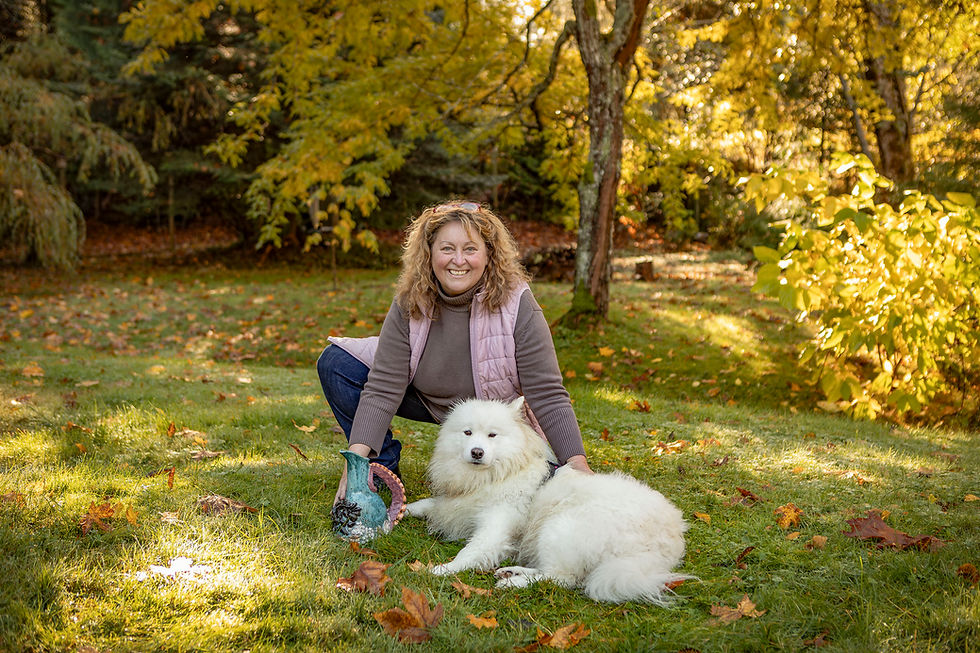
Over time, our products have continued to evolve based on what we see people actually need — not necessarily because something is a trend. We use every product that we make ourselves. And if it's not for us, sometimes it's for our dog, like Hana's Herbal Paw Balm, which uses our lavender and helichrysum essential oils.
So our focus has always been creating products based on what feels necessary, what we would personally use, and what we know others value. We hope to create products that are multifunctional, high quality, and made to be used and enjoyed for a long time — products that become something people know us for.
B: Our products depend on what grows here on the farm. By early summer, we've usually run out of the ingredients from our previous harvest, and we're waiting for this year's plants to be ready.
V: What inspires the scents you create?
B: While it starts with what we grow on our farm, we also wild harvest an interesting palette of botanicals and minerals from the forest and sea shore . Choosing the right ingredients is incredibly important. One of the main English lavenders we use for skincare and perfumes is a variety called “Maillette”. It is not the showiest lavender, and it is harder to grow, but its fragrance has remarkable depth and complexity.
The land itself also shapes that scent. You can't overstate its influence. Early on, we compared our Maillette essential oil with oils from France, the U.S., and other parts of Canada. Ours was never quite the same. It has more depth and is simply more interesting. Plants growing among mature trees produce a noticeably different oil than those grown in open fields and monocultures.
Formulation is another key part. Awatief and I share a philosophy: whenever possible, we like to use more than one expression of the same lavender. Take our Serenity Roll-On, for example. We infuse dried lavender buds into a carrier oil, then blend that with lavender essential oil. Each process draws out different qualities of the plant, and together they create a more complete expression of lavender. It is a very time-consuming process, but it gives the product much greater depth.
V: Beyond the farm, what influences the products you create?
A: Sometimes, when I visit my family in South Africa, I am introduced to unique oils and botanicals from the region, and I love incorporating them into our formulations. It adds another layer of uniqueness while bringing a part of my heritage and identity into what we create.
Rose geranium is one example. Native to South Africa, it felt like a meaningful plant to include because of that personal connection. Another example is Kalahari melon seed oil, which comes from wild-grown watermelons and shares some similarities with prickly pear oil. We use it in some of our formulations for its beautiful qualities.
We carefully select oils that are not only high quality, but also complement each formulation. We put so much care into what we grow here, and we would never dilute that by using ingredients that don’t meet our standards.
V: What are the challenges of being an island business?
A: Only about 10,000 people live on Salt Spring Island, so we rely on visitors coming to the farm as well as our online sales.
Sometimes it can be challenging to find help, and that is one reason we have chosen to keep the farm small. In many ways, it allows us to remain independent and stay closely connected to what we do.
B: But we have always believed that if you create good products, people will find you.
V: How would you describe the Salt Spring community?
B: It is such a vibrant and creative community. You are surrounded by artists, musicians, authors, and actors, and that brings a lot of inspiration.
A: It gives you confidence. So many people come here and reinvent themselves, discovering their passions and creating something new. We have really enjoyed following their example, in our own way.
V: How has farming changed your lifestyle?
A: We have always enjoyed supporting small businesses, going to markets, and buying from local producers. But living here and experiencing how much work goes into farming and caring for the land has made us appreciate other people's work on a much deeper level.
Now, when something at a store costs a little more, we don't hesitate. We can see when a maker has invested time, care, and attention to a product. That has been a big shift for us.
B: We see many people coming from the city who don't always understand that. They might assume farming is easier than it actually is. We often get comments like, "What a beautiful place to retire to," and I always have to say, “this is not retirement!” But it is incredibly rewarding.
V: What are your everyday essentials from your collection?
B: I use our Balancing Soap & Shampoo every day, and I wear our botanical perfumes, choosing a different one depending on the day.
A: There isn't a day that I don't use our Skin Serum, Hydrosol, and Natural Deodorant. Some products are part of our daily routine, while others are more special and intentional.
We have a beautiful Immortelle Botanical Body Butter that contains a high amount of immortelle. Every time I use it, I feel like it is something special that I save for moments when I want to treat myself. Sometimes we need those moments in our lives, and we are willing to pay a little more for something that feels meaningful and special.
V: What is your vision for the future?
A: We are starting to look at replanting certain areas of the farm. Lavender farms typically need to replant every 10 to 15 years as the plants become less productive, so we are beginning to think about the next phase of our lavender fields.
Another area we want to explore is growing our online presence and expanding into retail in a small, thoughtful way.
We would also like to continue developing our workshops. They bring together people who share a deep interest in lavender and botanicals, and we love sharing what we have learned with the next generation and those beginning their own journeys.
V: What is the meaning behind the name Lavender&Black?
B: When we looked at lavender-based businesses around the world, we saw a repetitive, predictable, and relatively old-fashioned approach to the farming, products, and branding. We started with a clean sheet of paper - bringing together natural farming practices, important complimentary botanicals (thus helichrysum and some of the other unique plants we grow or wild harvest), and then created a range of high quality, effective products with contemporary branding. The name “Lavender&Black”, along with our studio architecture and packaging design signal that we are not a typical lavender farm.


Lavender & Black
Lavender & Black is a family run farm, distillery and studio located on beautiful Salt Spring Island. Here we grow a wide range of flowers and aromatic herbs, including helichrysum, lavender, rosemary, sage, and many others. Together with sustainably gathered plants from the surrounding forest and sea, we have a rich palette of unique botanicals as the foundation of our product line.




SUPPORTED BY