

VOICE 181
Penny Eder
of
Searamics & Sculpture
Photography - HIRO Interview - MINA
"Life is too short to have plain dishes!"
Ceramic artist Penny Eder's home and studio are just one block from the Salish Sea in Courtenay, Vancouver Island. Her property, surrounded by a lush garden with a small creek running through the center, feels like a secret paradise. Occasionally, the sound of whale song might even drift in on the sea breeze. This is a picture-perfect environment for creative immersion, yet her life has been anything but smooth.
Before moving to the Island, Penny spent 20 years with her husband in Whistler, running a gallery while working on handcrafted tiles and public art. They would spend their summers sailing their large boat among the islands, a life many could only dream of.
However, by the end of 2020, when she arrived in Courtenay, she had lost everything. Having experienced divorce and lost both her home and gallery, she had to restart her life from scratch in a town where she knew no one. That period, amidst the pandemic, was one she refers to as "a time of hibernation." It was within this stillness that ceramics once again stirred her soul.
From one neighbour to another, word of her work began to spread. Today, four local galleries feature Penny's distinctive, narrative-rich pieces. From the bestselling "Sea Urchin Bowls," oyster dishes, mussel spoons, and sand dollar plates, to her newest "Tide Pool" series featuring charcuterie boards where starfish, octopuses, and barnacles nestling in "the pool" - her work captures a miniature universe of the seaside that is a joy to gaze at. The marine life and coastal scenes encountered during her two decades of sailing spring to life in her art. Her forms are intricate, almost lifelike, yet possess a distinct warmth. In every detail, you can feel her careful handwork and a deep affection for the sea.
"When I was at the bottom of my life, everyone encouraged me, saying, 'This isn't happening to you, it's happening for you.' Honestly, at the time, I didn't believe it at all. But I understand now. It was because of those experiences that I can now create every day in my happy place. I understand now that every experience was ultimately preparing me for the paradise I live in today.”
Her life's journey— breaking, remaking, and continuously changing form—is a powerful metaphor for the art of ceramics itself.
Let's explore the charm of her unique Searamic work in this VOICE feature.
VOICE (V): How did you get into the world of ceramic art?
Penny (P): My father used to build all kinds of structures on our property, and he worked a lot with cement. I think that's where my love for sculpting began. After high school, I actually received a scholarship to attend OCA (Ontario College of Art). But at the time, I couldn't imagine making a living as an artist, so I decided to go to Austria instead and teach skiing. Later, I became a flight attendant before eventually finding my way back to art. I first got into ceramics when my ex-husband and I were building our first house. I couldn't find the tiles I wanted, so I thought, "How hard could it be?" - and decided to make them myself. That's really how it all started. From there, people began asking me to create custom pieces for them. We loved entertaining guests at home, and whenever I couldn't find interesting plates or serving dishes, I would make my own. And now look at me! I never expected my artwork to grow the way it has. It's been such a wonderful journey.
V: Where do you find inspiration for your work?
P: I step outside! Williams Beach is one of my favourite places. Everything I make starts from an experience or something I've found. I've kept little treasures from the sea, shells, bits of coral, sea urchins, in a bag for over 25 years. I've carried that bag with me through all my moves 29 times in 30 years! When I create, I pick one of those objects and study it closely. I try to make my pieces as true to life as possible, inspired by things I've actually touched, smelled, and experienced. My mind never stops; everything I see or feel can become part of my work. Every piece is a work in progress.
V: How did you develop your unique style?
P: Almost everything I make is trial and error. You might need 30 years of breakage, damage, and testing to hone your skills. Even if you go to school, it's still a long process to figure out what works for you. I make what I want to make. If it sells, that's wonderful, but that's not my ultimate goal. My goal is to create what inspires me. I don't look at other people's work, because it can cloud my creativity and individuality.
V: Where does the name, White Dog Studio Searamics & Sculpture, come from?
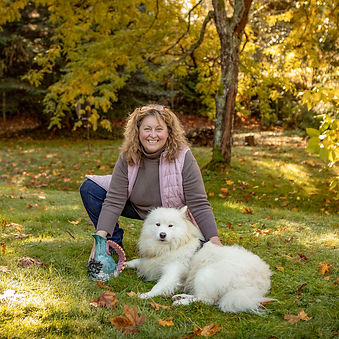
P: When I was in Whistler, everyone knew me by my three white dogs, so I called my gallery White Dog Studio Gallery. I still have the white dog, Marin, and now there's SEARAMIC. I love words that carry multiple meanings. The sea inspires everything I make, and the name came about as a playful pun. One word can mean three different things, and I just wanted it to be fun and different.
V: Would you say you are more of a sea person or a mountain person?
P: I love the mountains in winter. I grew up skiing, and being at the top of the summit with the wind blowing sideways is exhilarating. But I also really love the ocean. I'm a Cancer, the crab! Literally, if you look up the traits of Cancer, that's me. I'm a homebody, and when I feel afraid, I retreat into my shell.
V: How do you find the Comox Valley community?
P: I wanted to live on one of the islands, so I looked at Denman and Gabriola, and I wanted a more rural area because that's where I grew up. I'm so happy that I ended up in this area. Farms and small businesses define this area. Everywhere you look, local cottage enterprises are thriving. Lia from Clever Crow Farm was the first person I met when I moved here. My realtor had given me a gift certificate for their farm shop, and we became friends. She was the key to my introduction to the community. We are collaborating this holiday season on a gift box featuring my Moon Shell bowl alongside their BC Sea Salt & Sea Kelp!
V: Do you have the all-time favourite piece from your collection?
P: Every time I make something, it becomes my new favourite piece. Once, I made a large oyster platter with mussels, octopus, barnacles, and a starfish at the bottom. It turned out so perfectly that I didn't want to part with it. I eventually took it to the Salish Sea gallery and mentioned that I had a hard time giving it away. It sold out in a couple of days! There was an American woman who visited the gallery, fell in love with it, and heard my story. She told the gallery she would give it a good home. She returned the next day with a suitcase solely for carrying the piece onto the plane. That was definitely my favourite piece. I named the piece Black Pearl, tucking a real pearl into the corner of the bowl.
V: Do you have a message through your work?
P: I love sharing meals with friends, and I want the dishes we eat from to tell a story too. That's why I started making pieces inspired by the recipes I love - each designed to complement the food it holds. It always bothered me that you take pride in knowing how your food is grown, caught, or raised, yet you often place it on a plate without caring where that comes from. Unfortunately, people use mass-produced plates without considering the negative impacts of the overseas supply chain, including child labour, low wages, and environmental harm. I want my work to honour the all-around journey, from the ingredients to the vessel. When you use my pieces, every meal can be a mindful and meaningful experience.


Searamics & Sculpture
White Dog Studios SEA~Ramics & Sculpture overlooks the Salish Sea on Vancouver Island in beautiful British Columbia.
White Dog Studios are named for her love of the Samoyed dog breed. Penny welcomed Marin Princess of tides a few months after loosing her three such fur faces.
SEA~Ramics and Sculpture was born from Penny’s recent relocation from Whistler, BC
to Vancouver Island where she is now deeply inspired
by the ocean and the magnificent creatures that inhabit it.




SUPPORTED BY